Cash Basis Accounting: What It Is and When It Works

Short answer: cash basis accounting is a bookkeeping method that counts income the day the money actually lands in your account and counts expenses the day it actually leaves — nothing is recorded just because you sent an invoice or a bill showed up. It’s the default method for most sole proprietors and small businesses, and for many of them, it’s the right one to stay on.
One catch: past a certain size, or under a certain business structure, the IRS decides for you.
It’s the second Tuesday of the month and Marcus — I’ll call him Marcus — is staring at his business checking account, which reads $340, trying to work out how a freelance designer who just wrapped two five-figure branding projects is basically broke.
He invoiced $16,000 for those two projects three weeks ago, net 30. Nothing has landed yet. His books, kept on a cash basis, show $340 in income for the month, because that’s the literal cash that moved.
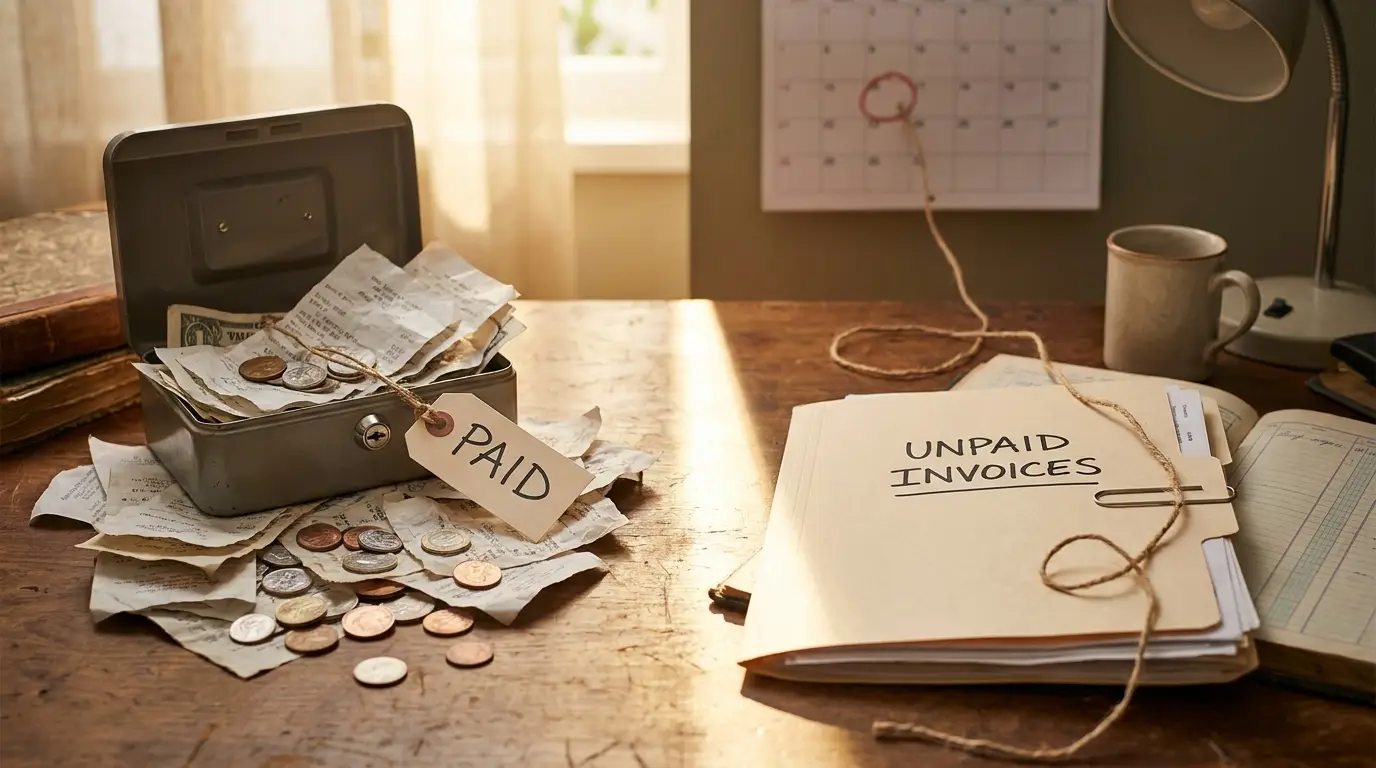
He isn’t broke. He’s rich on paper and poor in the bank, and cash basis accounting is exactly why he can’t tell the difference without looking twice.
What cash basis accounting actually means
It’s the same rule you already use for your personal checking account: money counts when it moves, not before. No separate ledger tracks what people owe you or what you owe someone else — the bank balance and the books are, for the most part, telling the same story.
- Income counts on the day it hits your account. Not the day you did the work, not the day you sent the invoice — the day the deposit actually clears.
- Expenses count on the day the money leaves. A bill sitting unpaid in your inbox isn’t an expense yet, no matter how firmly it’s due.
- There’s no accounts receivable or payable in the books themselves. You might track who owes you what in a separate spreadsheet, but it doesn’t touch the official cash basis numbers until cash actually changes hands.
- It’s the simplest of a few types of financial accounting a small business can choose from. Accrual and modified cash basis are the other two you’ll run into, and both exist to solve problems cash basis creates.
Cash basis vs. accrual accounting, in one example
Take Marcus’s $16,000 in invoices and watch what each method does with it.
- 1. He finishes the branding work in June. Under both methods, the work is done. Nothing else about the two methods agrees from here on.
- 2. He sends the invoices on June 30, net 30. Under accrual basis accounting, this is the moment the income counts — it’s earned, and the invoice date is the trigger.
- 3. Under cash basis, nothing has happened yet. Marcus’s June books show none of that $16,000, no matter how done the work is.
- 4. The clients pay in late July. Only now does cash basis record the income — a full month after accrual already had.
That one-month gap is the entire idea. One of the real benefits of accrual accounting is exactly this: it matches income to the period you actually earned it, so a June profit-and-loss statement shows June’s real performance instead of whichever invoices happened to get paid that month.

Who can actually use the cash method (and who can’t)
Most small businesses can legally stay on cash basis forever. The push to switch to accrual is usually about better decisions, not IRS orders — but a few structures don’t get the choice.
- Sole proprietors and freelancers. Free to use cash basis at any size, indefinitely.
- Most partnerships and S corporations. Also free to use it regardless of size, as long as there’s no C corporation in the ownership structure.
- Farming businesses and qualified personal service corporations. Carved out from the size limit entirely, with their own set of rules.
- C corporations, and partnerships with a C-corp partner. Restricted once average annual gross receipts over the prior three years cross a threshold that the IRS indexes for inflation every year. Cross it, and accrual stops being optional.
- Businesses with real inventory. Generally required to use accrual for the inventory portion of the business, unless they qualify for a small-business exception tied to that same gross-receipts threshold.
If none of the restricted categories fit you, this is a genuinely optional decision, not a compliance deadline. See what our bookkeeping and tax service actually covers if you’re weighing whether to sort this out yourself or hand it off.
Why most small businesses default to cash basis
It isn’t just the default because it’s legal. It’s the default because, for a lot of small businesses, it’s genuinely the right tool.
- It shows real cash in the bank. No guessing whether that $16,000 in invoices is actually spendable yet — the balance in the books is the balance you can act on today.
- It’s dramatically less bookkeeping. No aging reports, no tracking which invoices are outstanding, no reconciling promises against reality.
- It hands you real tax-timing flexibility. If Marcus holds off invoicing until January instead of December, that $16,000 doesn’t touch this year’s taxes at all — a legitimate, common way to manage which year looks profitable.
- It’s doable without software or training. A checking account and a habit of checking it is most of the system. That’s not a knock on it — if that’s genuinely your whole situation, decent free software or a spreadsheet is enough, and you don’t need to pay anyone to keep it that way.
The blind spot: what cash basis hides from you
Every strength above has a mirror-image weakness, and it’s the same one that had Marcus staring at $340 wondering where his month went.
- Money you’ve earned but not collected is invisible. On paper, a great month can look identical to a terrible one if the good invoices just haven’t been paid yet.
- Bills you owe but haven’t paid are also invisible. A flush-looking bank balance can be one big, unpaid invoice away from a very different picture.
- It isn’t GAAP-compliant. A bank underwriting a loan, an investor doing diligence, or a buyer evaluating your business will ask for accrual statements — cash basis numbers won’t satisfy them.
- It can quietly misprice your work. If your cash-basis numbers looked fine for a few months because of when invoices happened to get paid, you can underprice the next job without ever noticing the actual margin was thin.
Switching to accrual: what actually changes, and how
Nobody switches accounting methods for fun. It’s worth doing when the reason is specific, and it’s a real process once you decide.
- 1. Confirm you actually need the full switch. A lot of businesses only need to see receivables and payables clearly, not overhaul the whole ledger. That’s modified cash basis — cash basis day to day, with a side ledger tracking what’s owed and owing. It’s not a formal IRS method, but it’s a genuine, lighter-weight bridge.
- 2. File Form 3115, Application for Change in Accounting Method. Most small-business changes qualify as automatic changes, filed with the return for the year of the switch rather than needing advance IRS approval.
- 3. Work through the one-time catch-up adjustment. Switching methods can double-count or skip some income if it’s not handled — Form 3115 calculates a “section 481(a) adjustment” so the transition year comes out even.
- 4. Change how you enter transactions, not just what you report. QuickBooks and similar software can run cash or accrual reports off the same ledger — but only if invoices and bills are entered when they’re issued, not only when paid.
What flying blind on your numbers costs you
None of this is illegal or even unusual — most small businesses run cash basis their entire lives without a problem. The cost shows up quieter than a penalty: a slow season that feels sudden because the timing masked it, a job priced off a few good-looking cash-basis months instead of the real margin, or a loan application stalled because the bank wants accrual statements you’ve never had to produce.
The expensive version is the one where all of that lands at once — tax season, a lender’s deadline, and a scramble to reconstruct a year of receivables from memory and bank statements, because nobody was tracking them along the way.
There’s no invoice for that scramble, but do the arithmetic yourself: reconstructing a year of unpaid invoices and unbilled work after the fact takes real hours, at whatever your time is actually worth. A $299-a-month bookkeeping habit that tracks it as you go is, almost every time, the cheaper problem.
Frequently asked questions
- What is the difference between cash basis and accrual accounting?
- Cash basis records income and expenses when money actually moves — cash in, cash out. Accrual records income when you earn it (the invoice goes out, the job is done) and expenses when you incur them, whether or not cash has changed hands yet. The gap between the two only matters when there’s a delay between doing the work and getting paid for it, which for most small businesses is often.
- Is cash basis accounting GAAP compliant?
- No. Generally Accepted Accounting Principles require accrual accounting because it matches income to the period it was actually earned. Cash basis books are common and perfectly legal for tax purposes and day-to-day management, but a bank, investor, or buyer who wants GAAP-compliant financials will ask for accrual statements, not cash basis ones.
- What is the IRS gross receipts threshold for cash basis accounting?
- For C corporations and partnerships with a C corporation partner, the cutoff is based on average annual gross receipts over the prior three tax years, and it’s indexed for inflation every year under whatever revenue procedure the IRS issues that fall — Revenue Procedure 2025-32 set 2026’s figure in the low $30 millions. Because the number moves annually, it’s worth confirming the current one with us rather than trusting a figure in an old blog post, including this one.
- Can an LLC use cash basis accounting?
- Usually, yes. Most LLCs are taxed as sole proprietorships or partnerships by default, and both of those can use cash basis regardless of size. The gross receipts test only kicks in if the LLC elects to be taxed as a C corporation — at that point it’s playing by C-corp rules, cash basis included.
- When should a small business switch from cash to accrual accounting?
- Usually when the cash basis picture stops matching reality: you’re carrying real inventory, you’re chasing a bank loan or investor who wants accrual statements, or you keep being surprised by how much you actually made — or didn’t — each month. None of those are IRS deadlines. They’re just the point where better numbers start paying for themselves.
- How do you change your accounting method with the IRS?
- You file Form 3115, Application for Change in Accounting Method, generally attached to the tax return for the year of the change. It also calculates a one-time catch-up adjustment — a “section 481(a) adjustment” — so income already counted once under the old method doesn’t get counted again under the new one.
- What is modified cash basis accounting?
- A middle ground: keep cash basis for day-to-day income and expenses, but track a few accrual-style items on the side — usually accounts receivable, accounts payable, or inventory. It isn’t a formal method the IRS recognizes on its own, but plenty of small businesses run it internally as a bridge before a full switch to accrual.
- Can a business with inventory use cash basis accounting?
- Generally not for the inventory itself — accrual is standard once inventory is a real, material part of how you make money. There’s a small-business exception for companies under the same gross-receipts threshold that governs the cash method generally, which lets them treat inventory as non-incidental materials and supplies instead of full accrual inventory accounting. It’s a genuine exception, not a loophole, but confirm you qualify before relying on it.
More plain-English answers.
- Blog
Do you actually need an accountant?
Six honest signs it’s time, three signs it isn’t, and the real cost math — worth reading before you decide who should be watching these numbers.
Read more - Services
Bookkeeping and tax prep, explained plainly
What monthly bookkeeping, tax preparation, and audit support actually include — no jargon, no vague deliverables.
Read more - Pricing
Real prices. No “call for a quote.”
Three flat monthly plans, every fee on the page, including how one-time cleanup work gets quoted before you commit.
Read more
Not sure which method you’re even on?
Book a free 15-minute discovery call with Njock. Bring your books exactly as they are. We’ll tell you honestly whether cash basis is still serving you or whether it’s quietly costing you more than it’s saving.
Prefer to read on your own? More posts from the blog.