Can You Do Taxes Without a W-2? Yes — Here’s Exactly How

Short answer: yes — you can do taxes without a W-2. The IRS built a form for it, called Form 4852, where you report your wages and withholding from your own records instead. You do not need your employer to send anything, you do not need their permission, and you do not get to skip the deadline while you wait.
The missing paperwork is the small problem. Waiting is the expensive one.
Marcus worked at a print shop until it closed in October. Not dramatically — the owner just stopped opening, the sign came down, and that was that. In March, Marcus is sitting with a laptop, a shoebox of pay stubs, and a phone number for his old boss that rings once and disconnects. Everyone he asks tells him the same unhelpful thing: you need your W-2.
He does not, actually. He needs the numbers that were going to be printed on it — and he has been holding most of them the whole time.
This is one of the most common questions we get between February and April, and it is almost always solvable in an afternoon. Here is the order to do it in.
Start here: it might not be missing yet
Before you reach for a substitute form, rule out the boring explanations. Most missing W-2s are not missing — they are late, mailed to an old address, or sitting in a payroll portal nobody told you about.
- 1. Check the date before you panic. Employers have to get your W-2 to you by January 31 — it slides to the next business day when that lands on a weekend. If it is the first week of February, nothing has gone wrong yet.
- 2. Check the payroll portal, not just the mailbox. If your employer used a payroll provider, your W-2 is very likely sitting in an online account you can still reach — even if the business itself has closed. The provider is a separate company and their records outlive your employer.
- 3. Ask the employer directly, once, in writing. The IRS asks you to do this first, and a written request gives you a dated record that you tried. Email is fine. Confirm the address they have on file while you are at it.
- 4. After the end of February, call the IRS. Per the IRS’s own guidance on missing W-2s, you can call them at 800-829-1040 once February is over. Have your name, address, Social Security number and dates of employment ready, plus your employer’s name, address and EIN if you can find it — an old pay stub usually has it. The IRS will contact the employer for you.
If any of those four steps produces the W-2, you are done and the rest of this post is not your problem. Genuinely — most people stop here.
The IRS wrote a form for exactly this problem
When the W-2 genuinely is not coming, you file anyway using Form 4852, the Substitute for Form W-2. It exists for two situations: your employer never sent the form, or they sent one that is wrong.
It is a one-page form. You fill in what you earned and what was withheld, explain how you worked the numbers out, and describe what you did to try to get the real thing. Then it goes in with your return like any other attachment.
- You estimate, honestly. The form asks for your best figures, not certified ones. Nobody expects you to have accounting-grade precision on a form whose entire premise is that the paperwork went missing.
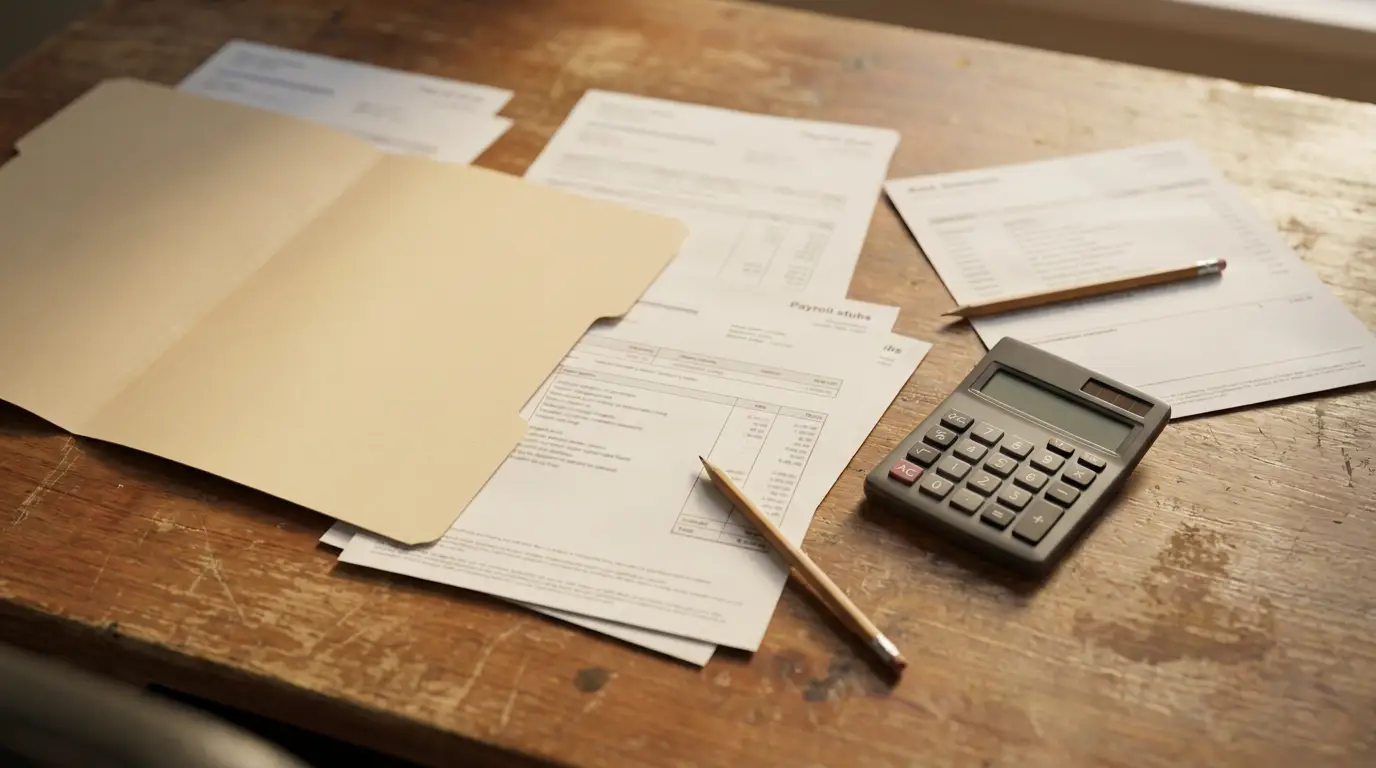
- Your last pay stub is the star witness. Final stubs of the year usually carry year-to-date totals for gross wages, federal withholding, Social Security and Medicare. That is most of a W-2 already.
- You show your working. The form has a line asking how you determined the amounts. Be specific — “year-to-date totals from my final pay stub, dated 12/20” is a real answer.
- If the real W-2 shows up later and differs, you amend. That is Form 1040-X. It is a normal, unremarkable thing to file and it is not an admission that you did anything wrong.
The shortcut: get your wage data from the IRS
Here is the part most people never find out about. Your employer did not only send that W-2 to you — they filed a copy with the government. The IRS will give you that data back, for free, in something called a Wage and Income Transcript.
It lists the W-2s, 1099s and other information returns filed under your Social Security number for a given year. If your employer filed their copy — and most do even when they are falling apart — your numbers are already sitting on an IRS server waiting for you to ask.
- Online is fastest. Through your IRS individual online account you can pull it immediately. Setting up the account takes identity verification, which is the slow part.
- By mail takes 5–10 days. You can also request one by phone on 800-908-9946 if you would rather not create an online account.
- It is free. Anyone charging you a fee to retrieve your own transcript is selling you a phone call you could make yourself.
- It is not instant for the current year. Wage data takes time to post after employers file. For a very recent tax year the transcript may be thin or empty well into the filing season — which is exactly when Form 4852 earns its keep.
What you actually need to file without a W-2
Strip away the anxiety and the list is short. You are trying to reconstruct four numbers and prove where they came from.
- 1. Total wages for the year. Year-to-date gross on your final pay stub. If stubs are missing too, bank deposits plus your pay rate and dates worked will get you close enough to estimate honestly.
- 2. Federal income tax withheld. This one matters most — it is money already paid on your behalf, and understating it means overpaying your own tax bill.
- 3. Social Security and Medicare withheld. Also on the stub. These do not change your income tax but they belong on the form.
- 4. Employer name, address and EIN. The EIN is a nine-digit number printed on old pay stubs and on any prior-year W-2 from the same employer.
If that is your whole situation — one employer, one missing form, stubs in hand — this is genuinely a do-it-yourself afternoon. You do not need to hire anyone, and we would tell you the same thing on a call. Where it stops being simple is when the missing W-2 sits on top of something else: multiple years, a business of your own, or a notice from the IRS that already arrived.
What if you didn’t have a job at all?
“Can you file taxes without a job?” is a slightly different question hiding inside the same worry, and the answer is also yes. A W-2 is evidence of employment income. Plenty of people have taxable income without an employer, and plenty of people with no income at all still benefit from filing.
- Self-employed, gig, or 1099 work. No W-2 is expected here at all. You report the income on Schedule C, deduct genuine business expenses, and handle self-employment tax. Missing 1099s do not stop you either — your own records are the authority, and you owe tax on the income whether or not anyone sent a form.
- Unemployment, interest, or retirement income. These arrive on their own forms — 1099-G, 1099-INT, 1099-R — and are reported the same way.
- No income whatsoever. You usually have no filing requirement. Filing anyway can still be worth it: refundable credits, a filed return for income verification when you rent or borrow, and a clean record rather than a silent gap.
If a chunk of your year was self-employment, the missing W-2 is probably not your biggest question — how the business side gets recorded is.

What if it’s not one year — it’s three?
A missing W-2 is often how someone discovers they are further behind than they thought. One skipped year turns into two because the first one is unresolved, and by year three the whole thing has become something you avoid thinking about after 9pm.
The mechanics are less frightening than the feeling.
- The IRS may file for you — badly. If you do not file, they can prepare a Substitute for Return using the income reported by employers and banks, with no deductions and none of the credits you would have claimed. The resulting bill is usually much larger than what you actually owed. You can replace it by filing your own return.
- Refunds expire, bills do not. You generally have three years from the original due date to claim a refund. Miss that window and money the government owed you simply stops being available. Tax you owe has no such kindness.
- Wage transcripts make catch-up work possible. This is the practical reason the transcript matters so much for multi-year situations — you can reconstruct several years of income from IRS records even when your own paperwork is long gone.
- Do the years together, not one at a time. Numbers carry forward between years. Filing them piecemeal tends to create corrections you then have to unwind.
This is the point where an accountant stops being optional overhead and starts being cheaper than the alternative — not because the forms are hard, but because sequencing several years correctly is the whole job. If you want to see what that looks like before committing to anything, our pricing is on the page and the first 30 days are written out.
What waiting actually costs
Here is the number that should change your afternoon. The IRS charges two separate penalties, and people consistently fear the wrong one.
The failure-to-file penalty is 5% of the tax you owe, per month, capped at 25%. The failure-to-pay penalty is 0.5% per month. Read those again: not filing costs ten times more per month than not paying.
Which means the worst possible move — the one that feels safest when the paperwork is missing — is to hold the return back until everything looks tidy. If you owe $4,000 and file five months late, the filing penalty alone reaches its 25% ceiling: $1,000, for the sin of waiting. Had you filed on time and paid five months late, you would be looking at roughly a tenth of that.
There is also a floor. For returns filed more than 60 days late, the minimum penalty is the lesser of $525 or 100% of what you owe — so even a small balance can carry a disproportionate charge.
File with your best estimate. Amend later if you have to. The amendment is free; the delay is not.
Frequently asked questions
- Can I file my taxes without my W-2?
- Yes. The IRS created Form 4852 — the Substitute for Form W-2 — for exactly this. You estimate your wages and withholding from your own records, attach the form to your return, and file on time. You do not need your employer’s cooperation to use it.
- How accurate do my numbers have to be on Form 4852?
- They have to be your honest best estimate, and you have to explain on the form how you arrived at them. Your final pay stub of the year is usually the strongest evidence because it carries year-to-date totals for both wages and withholding. If the real W-2 turns up later and the numbers differ, you file an amended return.
- What happens if I didn’t file last year’s taxes?
- File as soon as you can, even if you cannot pay. The failure-to-file penalty runs at 5% of the tax due per month, capped at 25%. The failure-to-pay penalty is 0.5% per month. Filing late and paying late is roughly ten times more expensive per month than filing on time and paying late.
- Can you file taxes without a job?
- Yes, and sometimes you should even when you are not required to. If you had no income at all you generally have no filing requirement, but filing a return can still be worth it to claim refundable credits, to create a record for income verification, or to start the clock on the statute of limitations.
- What happens if you don’t file taxes for 3 years?
- The IRS can file a Substitute for Return on your behalf, calculated with no deductions and no credits you would have claimed — so the bill is usually far higher than reality. You can still file your own returns to replace it. Note that refunds generally expire three years after the original due date, so an unfiled year with a refund owed to you can time out permanently.
- Can I file 2025 taxes without filing 2024?
- Technically yes, and it is better than filing nothing. But an unfiled prior year does not go away, and it can hold up a refund on the year you did file. If you are missing more than one year, deal with them together rather than one at a time.
- Are tax relief companies that promise to settle my debt legit?
- Some are legitimate; many are not. Be sceptical of anyone who guarantees a settlement amount before reviewing your transcripts, asks for a large fee up front, or tells you to stop communicating with the IRS. Offers in Compromise are real but genuinely uncommon, and the IRS publishes its own qualification tool for free.
- Will filing with Form 4852 delay my refund?
- Often, yes. The IRS may verify your wage figures with the Social Security Administration before releasing a refund, which can add weeks. It is still faster than not filing, and it stops penalties from accruing.
More plain-English answers.
- Blog
Do you actually need an accountant?
Six honest signs it’s time, three signs it isn’t, and the real cost math — including when the answer is that software is still enough.
Read more - Services
Tax preparation and catch-up bookkeeping
What we actually do when your books are behind: federal, state and local returns, rebuilt month by month from whatever you have.
Read more - Pricing
Real prices. No “call for a quote.”
Three plans, all-in, every fee on the page — including how one-time cleanup work is quoted before you commit.
Read more
Missing more than one form?
Book a free 15-minute call with Njock. Bring whatever you have — a shoebox is fine. We will tell you honestly whether this is a form you can file yourself this afternoon or something worth handing over.
Prefer to read on your own? More posts from the blog.